Yoga for Knee Pain & Knee Strengthening Exercises: Your Daily Ayurvedic Routine for Osteoarthritis Relief
A doctor-guided routine that combines gentle yoga for knee pain, targeted knee pain exercises, and classical Ayurveda — so you can sit, climb stairs, and walk with less pain, one day at a time.
A daily 20–30 minute routine combining gentle yoga for knee pain (Cat-Cow, Bridge Pose, Legs-Up-The-Wall) with targeted knee strengthening exercises (quad sets, straight leg raises, supported wall squats) can meaningfully reduce stiffness and improve mobility in mild-to-moderate knee osteoarthritis — especially when paired with Ayurvedic support such as warm oil massage and Janu Basti therapy.
If getting up from a chair, climbing a flight of stairs, or sitting cross-legged on the floor has slowly turned into a daily struggle, you are far from alone. Knee pain and knee osteoarthritis affect a large share of adults in India, and for most people, the first real question is simple: what can I do myself, every single day, to feel better?
This is exactly where a combination of yoga for knee pain, structured knee pain exercises, and Ayurveda's centuries-old understanding of joint health comes together into one practical daily routine.
At Ayusanjivani Ayurveda, with clinics in Kharadi and Wagholi, Pune, we're asked this almost every day — by patients managing early morning stiffness as well as those with more advanced knee joint degeneration. In this guide, we break down safe, physician-reviewed exercises for knee arthritis, gentle yoga poses, and knee strengthening exercises you can begin at home, supported by Ayurvedic principles that work on the root cause rather than only the symptom.
What's Covered in This Guide
- Understanding Knee Pain in Ayurveda
- Why Yoga & Exercise Actually Help
- Safety Guidelines Before You Begin
- A 5-Minute Warm-Up Routine
- Yoga for Knee Pain: 8 Gentle Poses
- Knee Strengthening Exercises
- Your Daily Ayurvedic Routine
- Complementary Ayurvedic Therapies
- Diet & Lifestyle Support
- When to See a Doctor
- Frequently Asked Questions
Understanding Knee Pain and Osteoarthritis Through an Ayurvedic Lens
Knee pain rarely appears overnight. It builds up gradually — a little stiffness after sitting too long, a click when you climb stairs, a dull ache by evening. In modern medical terms, this is usually knee osteoarthritis: the slow wearing down of the cartilage that cushions the joint. Ayurveda describes the same process differently, and in many ways more usefully for day-to-day self-care.
In Ayurveda, the knee joint is governed largely by Vata dosha, the subtle energy responsible for all movement in the body. When Vata becomes aggravated — through age, cold weather, irregular routine, excess dry or cold foods, or long periods of inactivity — it dries out the Shleshaka Kapha, the natural lubricating fluid that keeps the joint smooth. The resulting condition is called Sandhivata: pain, stiffness, a grinding or clicking sound (crepitus), and swelling in the knee joint.
This is exactly why the common advice to "just rest the knee completely" so often backfires. Sandhivata is fundamentally a Vata disorder, and Vata is pacified through gentle, rhythmic, warmth-generating movement — not through total immobility. This is the core principle behind pairing yoga for knee pain with structured knee pain exercises: movement is the medicine, but it has to be the right kind of movement, done the right way, at the right pace.
If you're unsure whether your discomfort is early-stage stiffness or more advanced joint degeneration, it helps to first read our grade-wise guide to knee arthritis symptoms, and if needed, understand how a proper Ayurvedic diagnosis of arthritis is carried out before you begin any home routine.
Why Yoga and Exercise Actually Help an Arthritic Knee
It's a fair question: can gentle movement really make a difference to a joint that's already worn down? Both classical Ayurveda and modern rehabilitation science agree — yes, with the right approach. Regular, low-impact movement does four specific things for a knee affected by osteoarthritis:
- Improves circulation to the joint capsule, bringing nutrients to cartilage tissue that otherwise has very limited direct blood supply.
- Strengthens the quadriceps and hamstrings — the muscles that act as natural shock absorbers, taking load off the joint surface itself. This is the whole logic behind knee strengthening exercises.
- Maintains range of motion, preventing the additional stiffness that comes from prolonged disuse.
- Reduces Vata aggravation through rhythmic, warming movement paired with steady breathing — the reason yoga for knee pain tends to work differently, and often more sustainably, than generic stretching alone.
Because of this, our clinical approach never treats exercise as a stand-alone fix. It works best as one part of a complete plan that may include therapies such as Janu Basti and, where appropriate, Panchakarma detoxification — alongside the daily routine covered in this guide. For a broader clinical picture, our detailed guide to Ayurvedic management of knee osteoarthritis is a useful next read.
Safety Guidelines — Please Read This Before You Begin
Exercise and yoga are powerful tools for knee osteoarthritis, but only when done correctly. Keep these points in mind every time you practice:
- Get a proper diagnosis first if you haven't already — this routine is built around confirmed osteoarthritis, not undiagnosed knee pain.
- This guide is designed for mild-to-moderate (Grade 1–2) knee osteoarthritis. If your condition is more advanced, or you're currently dealing with acute inflammation, it's worth first reviewing our approach to non-surgical knee arthritis treatment so your routine can be adjusted appropriately.
- Never push into sharp or shooting pain. Mild discomfort during a stretch is normal; sharp, stabbing, or radiating pain is a signal to stop immediately.
- Always warm the joint before stretching it — never stretch a cold, stiff knee first thing.
- Use props generously: a folded blanket, a sturdy chair, a wall, or a yoga strap all make these poses safer and more effective.
- Keep every movement slow and controlled. Avoid bouncing, jerky, or ballistic motions entirely.
- If your knee is visibly swollen, warm to the touch, or you have fever alongside joint pain, stop and consult your doctor — this can indicate an acute flare, or a different condition such as rheumatoid arthritis rather than simple wear-and-tear osteoarthritis.
- Practice on an empty stomach, or at least two hours after a meal — ideally in the morning.
Not sure which stage your knee arthritis is at?
Our physicians at Kharadi and Wagholi can assess your knee and tailor this routine, along with the right Ayurvedic therapies, to your specific condition.
A 5-Minute Warm-Up (Do This Every Time)
Never begin yoga poses or knee strengthening exercises on a cold, stiff joint — this is one of the most common mistakes we see in patients starting a home routine. Spend five minutes on the following before every session:
- Ankle pumps and circles — 10 repetitions each direction, both feet.
- Gentle marching in place — lift knees only as high as comfortable, for about 1 minute.
- Hip circles — hands on hips, small controlled circles, 10 each direction.
- Warm oil self-massage of the knee — using sesame oil or a physician-prescribed Ayurvedic oil, gentle upward circular strokes for 2–3 minutes.
This warm-up mirrors the Ayurvedic principles of Snehana (oleation) and Swedana (gentle warming) that are always applied before any joint therapy — the same logic behind treatments like Abhyanga oil massage.
Yoga for Knee Pain: 8 Gentle, Effective Poses
These are the poses we most often recommend to patients managing knee osteoarthritis. Each one is included for a specific reason — it either strengthens a muscle group supporting the knee, or improves flexibility and circulation without loading the joint directly. Move slowly, breathe steadily, and stop at the first sign of sharp pain.
1. Tadasana (Mountain Pose)
Foundational alignment poseBuilds awareness of how your body weight distributes through your hips, knees, and ankles — the foundation every other pose in this list builds on.
How to practice:
- Stand with feet hip-width apart, weight spread evenly across both feet.
- Soften your knees very slightly — do not lock them.
- Lengthen your spine, relax your shoulders, and breathe evenly for 8–10 breaths.
2. Marjaryasana–Bitilasana (Cat-Cow Pose)
Spinal mobilisation, zero knee loadGently mobilises the spine and hips while placing no direct weight-bearing stress on the knee joint itself — an excellent starting pose for stiffer mornings.
How to practice:
- Come onto all fours with a folded blanket under your knees for cushioning.
- Inhale, drop your belly, lift your chest and tailbone (Cow).
- Exhale, round your spine, tuck your chin and tailbone (Cat).
- Repeat slowly for 8–10 rounds, moving with your breath.
3. Setu Bandhasana (Bridge Pose)
Glute & hamstring activationOne of the most effective poses for building strength in the glutes and hamstrings, which take pressure off the front of the knee joint during daily activities like walking and climbing stairs.
How to practice:
- Lie on your back, knees bent, feet flat and hip-width apart, close to your hips.
- Inhale, press through your feet, and lift your hips slowly off the floor.
- Hold for 3–5 breaths, keeping the lift comfortable and controlled.
- Exhale and lower down slowly. Repeat 5–8 times.
4. Supta Padangusthasana (Reclined Hand-to-Big-Toe, with strap)
Hamstring & calf stretchStretches tight hamstrings and calves without any bodyweight passing through the knee — tightness here is a very common, overlooked contributor to knee stiffness.
How to practice:
- Lie on your back, loop a yoga strap or long towel around the ball of one foot.
- Keeping the other leg bent and flat on the floor, straighten the strapped leg toward the ceiling.
- Hold the gentle stretch for 5–8 breaths, then switch sides.
5. Modified Trikonasana (Supported Triangle Pose)
Thigh strength & alignmentStrengthens the thigh muscles and improves overall leg alignment, using a block for support so the front knee is never forced into a deep, unsupported angle.
How to practice:
- Stand with feet wide apart, front foot pointing forward, back foot turned slightly in.
- Extend your arms parallel to the floor, hinge at the hip toward the front leg.
- Rest your front hand on a yoga block or a chair seat, not the floor.
- Keep the front knee soft, aligned over the second toe. Hold for 5 breaths, switch sides.
6. Supine Figure-4 Stretch (Reclined Pigeon)
Hip & IT-band releaseReleases tightness in the hips and IT band — an area that frequently refers tension and discomfort straight down into the outer knee.
How to practice:
- Lie on your back, knees bent, feet flat on the floor.
- Cross one ankle over the opposite knee, forming a figure-4 shape.
- Gently draw the uncrossed thigh toward your chest until you feel a stretch in the hip of the crossed leg.
- Hold 5–8 breaths, then switch sides.
7. Balasana (Child's Pose, Modified with Support)
Gentle rest & decompressionA calming rest posture that relieves compressive load on the knees when practiced with proper cushioning, and lowers overall stress — an important factor in Vata balance.
How to practice:
- Kneel on a folded blanket, placing a rolled towel behind the knees if there is any pinching.
- Sit back toward your heels only as far as is comfortable — a small gap is fine.
- Fold forward, resting your forehead on the floor or a block, arms extended or by your sides.
- Breathe slowly for 6–10 breaths. Prefer a chair-seated forward fold if kneeling is uncomfortable.
8. Viparita Karani (Legs-Up-The-Wall Pose)
Restorative, reduces swellingReduces fluid retention and mild swelling around the knee and ankle while calming the nervous system. This is safe for nearly every stage of knee osteoarthritis and an excellent pose to close your practice with.
How to practice:
- Sit sideways next to a wall, then swing your legs up the wall as you lie back.
- Rest your legs against the wall, knees very softly bent if that feels more comfortable.
- Relax your arms by your sides, close your eyes, and breathe naturally for 5–10 minutes.
Knee Strengthening Exercises for Arthritis
Yoga builds flexibility and circulation; the exercises below build the muscular strength that actually protects the joint through your day. This is where knee strengthening exercises earns its name — the goal here is stronger quadriceps and hamstrings, not a deeper stretch.
1. Quadriceps (Quad) Sets
Sit or lie with the affected leg straight. Tighten the thigh muscle, pressing the back of the knee down into the floor or mat. Hold 5 seconds, release. Repeat 10 times, both legs. This is often the very first exercise prescribed after any knee injury or flare, since it strengthens the quad without any joint movement at all.
2. Straight Leg Raises
Lie on your back, one knee bent and foot flat, the other leg straight. Tighten the straight leg's thigh and lift it to the height of the bent knee. Hold 2–3 seconds, lower slowly. Repeat 10 times per leg. Builds quad strength without bending a painful joint through its full range.
3. Seated Knee Extensions
Sit tall in a sturdy chair. Slowly straighten one knee until the leg is extended, hold 3 seconds, then lower with control — do not let it drop. Repeat 10–12 times per leg. A simple, effective way to isolate the quadriceps in a fully supported position.
4. Supported (Partial) Wall Squats
Stand with your back against a wall, feet shoulder-width apart, slightly forward. Slide down only a few inches into a very shallow squat, hold 5 seconds, and slide back up. Repeat 5–8 times. Never go deeper than a comfortable, pain-free range.
5. Heel Slides
Lie on your back, both feet flat. Slowly slide one heel toward your hips, bending the knee as far as comfortable, then slide it back straight. Repeat 10 times per leg. Restores gentle bending range of motion, especially useful after a stiff morning.
6. Standing Hamstring Curls
Stand holding a chair or wall for support. Slowly bend one knee, bringing the heel up toward your glutes, then lower with control. Repeat 10 times per leg. Balances quad-focused work with hamstring strength, which is equally important for knee stability.
For a deeper, condition-specific plan that pairs these exercises with herbal and therapeutic support, see our article on Ayurvedic tips for knee cartilage regeneration and our guide on cartilage regeneration and long-term joint health.
Want a routine designed around your exact knee grade?
Book an in-person assessment at our Kharadi or Wagholi clinic and get a home routine matched to your specific stage of osteoarthritis.
Your Daily Ayurvedic Routine (Dinacharya) for Knee Osteoarthritis
Consistency matters more than intensity when it comes to knee pain exercises. Here is how we typically recommend spacing this routine through your day, following the Ayurvedic principle of Dinacharya — a fixed daily rhythm that itself helps pacify aggravated Vata.
Warm-up + Yoga for Knee Pain
Begin with the 5-minute warm-up and warm oil self-massage, followed by the full 8-pose yoga sequence (20 minutes). Mornings are when Vata-related stiffness is highest, making gentle, warming movement especially important at this time.
Movement & Light Walking
A 15–20 minute walk on a flat, even surface, worn with supportive footwear. Avoid prolonged sitting in one position; stand and gently move every 45–60 minutes if you have a desk-based day.
Knee Strengthening Exercises
Complete the 6-exercise strengthening set (15 minutes). Evenings are ideal for strength work once the joint has been moving through the day and is less stiff than first thing in the morning.
Restorative Pose & Oil Application
Close the day with Viparita Karani (Legs-Up-The-Wall) for 5–10 minutes, followed by a gentle application of a physician-prescribed medicated oil before sleep. This supports overnight Vata pacification.
| Time | Focus | Approx. Duration |
|---|---|---|
| Morning | Warm-up + Yoga for knee pain | 25–30 minutes |
| Midday | Flat-surface walking | 15–20 minutes |
| Evening | Knee strengthening exercises | 15 minutes |
| Night | Restorative pose + oil application | 10–15 minutes |
Ayurvedic Therapies That Complement This Routine
Home exercises and yoga form the daily foundation, but they work best alongside clinical Ayurvedic therapies designed specifically for the knee joint. At our Kharadi and Wagholi clinics, this typically includes:
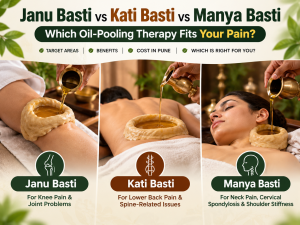
- Janu Basti — a specialised knee-joint therapy where warm medicated oil is retained around the knee within a dam of dough, delivering deep, sustained lubrication that self-massage alone cannot achieve. Read our comprehensive guide to Janu Basti for full details on the procedure.
- Abhyanga (whole-body oil massage) — supports overall Vata balance, not just local knee relief. Learn more about how Abhyanga supports mind-body health.
- Panchakarma detoxification — recommended in select cases to address deeper, systemic Ama (toxin) build-up contributing to joint degeneration. Explore our Panchakarma programs at our Kharadi clinic.
- Classical herbal formulations — such as Mahanarayan Taila and Ksheerabala Taila for external application, and internal Vata-pacifying formulations, always prescribed after a physician consultation rather than self-administered.
For patients with more advanced joint changes who are exploring every option before considering surgery, our detailed article on the full Ayurvedic osteoarthritis treatment program at our clinic walks through what a complete, physician-supervised plan looks like.
Diet & Lifestyle Support for Joint Health
Exercise and yoga address the mechanics of the knee joint; diet addresses the internal environment Ayurveda believes drives Sandhivata in the first place. A few consistent habits go a long way:
- Favour warm, freshly cooked, lightly spiced meals over cold, raw, or leftover food, which tends to aggravate Vata.
- Include a moderate amount of ghee in your diet, which Ayurveda considers naturally lubricating for joint tissue.
- Limit deep-fried, overly dry, and packaged/processed foods.
- Maintain a healthy body weight — every extra kilogram adds measurable load to the knee joint with each step you take.
- Stay well hydrated through the day with warm or room-temperature water.
- Keep the knees warm in cold or damp weather, and avoid direct exposure to cold air or cold flooring for long periods.
- Choose supportive, cushioned footwear, and avoid prolonged floor-sitting with deeply bent knees if your joint is already stiff.
When to See a Doctor (Red Flags to Watch For)
This routine is designed to be safe for most people with confirmed mild-to-moderate knee osteoarthritis. However, stop the routine and seek a proper clinical evaluation if you notice any of the following:
- Sudden, severe swelling or a knee that becomes hot and red to the touch.
- Fever accompanying joint pain, which can point toward an inflammatory or infective cause rather than simple osteoarthritis.
- Complete inability to bear weight on the affected leg.
- The knee "locking," giving way, or buckling unexpectedly.
- Pain that consistently disrupts sleep or steadily worsens week over week despite rest.
- Symptoms that seem more widespread or symmetrical than a single worn joint — this pattern is worth ruling out for conditions such as rheumatoid arthritis or gouty arthritis (Vatarakta), both of which need a different treatment approach than plain wear-and-tear osteoarthritis.
If any of this sounds familiar, it's best to get a clinical assessment before continuing a self-directed routine. Our arthritis diagnosis process is a good starting point to understand what's actually happening in your knee joint.
Reviewed by Dr. Shailesh Shamkant Phalle
BAMS, M.D. Kayachikitsa · Founder, Ayusanjivani Ayurveda
Dr. Phalle and his team specialise in Ayurvedic management of joint disorders, including knee osteoarthritis, through Janu Basti, Panchakarma, and structured lifestyle-based care, across the clinic's Kharadi and Wagholi centres in Pune.
Frequently Asked Questions
Yoga cannot regrow lost cartilage, but consistent practice of yoga for knee pain can significantly reduce pain, stiffness, and improve function, especially in mild-to-moderate osteoarthritis. It works best as part of a complete plan that includes strengthening exercises, Ayurvedic therapies like Janu Basti, and diet changes — not as a stand-alone cure.
Ideally, daily. Knee pain exercises and yoga work through consistency rather than intensity — short daily sessions of 20–30 minutes generally produce better, more lasting results than longer sessions done only a few times a week.
They serve different purposes and work best together. Walking on a flat surface maintains general fitness and circulation, while yoga and targeted exercises for knee arthritis specifically address flexibility, muscle strength, and joint stability in ways ordinary walking does not.
Only under the guidance of your operating surgeon and physiotherapist, and typically not until you have cleared an initial recovery period. Once cleared, many of the gentler poses in this guide — such as Legs-Up-The-Wall and Cat-Cow — are commonly reintroduced first.
Neither replaces the other. Yoga improves flexibility, circulation, and Vata balance; knee strengthening exercises build the muscular support that actually protects the joint. The daily routine in this guide is built around doing both, at different times of day.
Most patients notice reduced morning stiffness within 2–3 weeks of consistent daily practice. Meaningful improvement in overall function and pain levels usually takes 6–8 weeks, and is generally faster when the routine is combined with therapies like Janu Basti.
Yes — avoid deep, unsupported squats, full Virasana (kneeling with hips between the heels) without support, deep lunges, and any pose that forces the knee into a fully bent, weight-bearing position without props. When in doubt, use a modified or chair-supported version instead.
Ayurveda focuses on nourishing joint tissue, reducing further degeneration, and improving the joint's internal environment through therapies like Janu Basti and targeted herbal formulations, alongside exercise. For a detailed look at this approach, see our guide on Ayurvedic tips for knee cartilage regeneration.
Visit Us — Ayusanjivani Ayurveda
Both our clinics offer in-person knee assessments, Janu Basti therapy, and personalised daily-routine planning for knee osteoarthritis.
📍 Kharadi Clinic
Home of our full Panchakarma set-up and knee joint therapy programs. Read more about our Kharadi clinic here.
📍 Wagholi Clinic
Convenient consultations and follow-up care for patients across Wagholi and the surrounding areas of Pune.
Ready to Build a Knee Care Routine That Actually Fits Your Condition?
Every knee is different. Speak with our Ayurvedic physicians in Kharadi or Wagholi to get a routine, therapy plan, and diet guidance built around your specific stage of knee osteoarthritis.
This article is for general educational purposes and does not replace an in-person medical or Ayurvedic consultation. Please consult a qualified physician before starting any new exercise routine, especially with pre-existing joint or medical conditions.