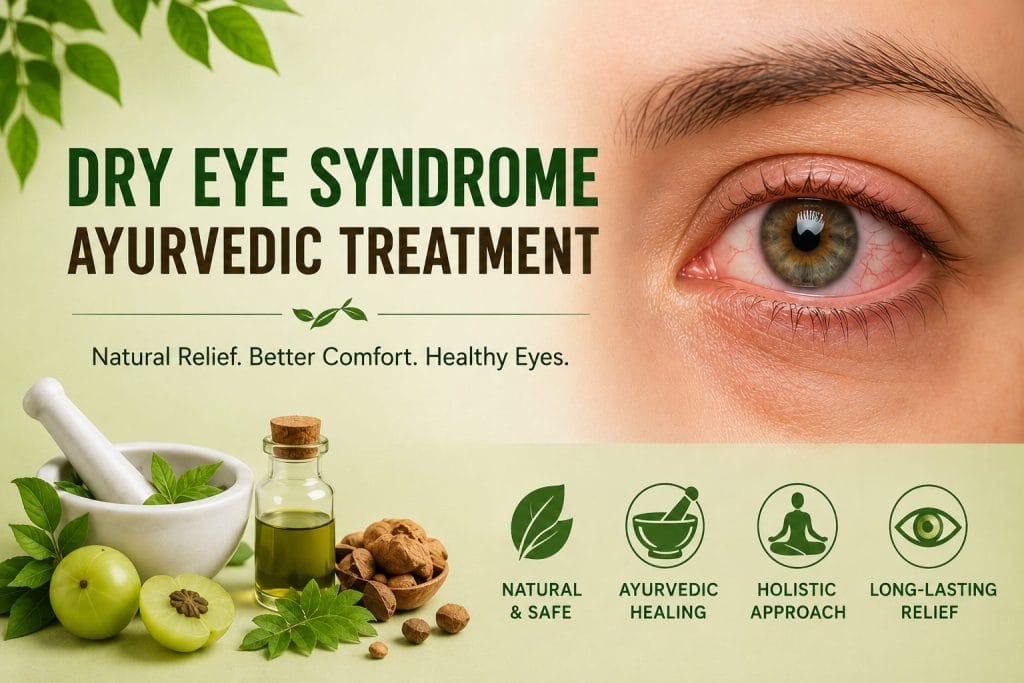
In today’s digital an social era, our eyes are constantly exposed to stress—endless hours on mobile phones, computers, air-conditioned rooms, and even late-night screen bingeing. The result? Dry eyes, burning, irritation, and blurred vision.in this article blog we will discuss in detail about dry eye syndrome ayurvedic treatment in detail.
While modern eye drops offer quick relief, the problem often returns. Ayurveda, on the other hand, works on the root cause, nourishing the eyes naturally and restoring long-term balance.
What is Dry Eye Syndrome?
Dry Eye Syndrome usually occurs when your eyes don’t make enough tears or when the tears evaporate too quickly. Tears are not just “water” but a protective, lubricating fluid containing oils, enzymes, and mucus.
Without enough tear film, the eyes feel scratchy, dry, and tired always.
Ayurvedic Understanding – “Shushkakshipaka” :
In Ayurveda, dry eyes are described as Shushkakshipaka, a condition caused by imbalance of Vata (dryness, roughness) and Pitta (heat, burning). It weakens the natural Tarpaka Kapha (lubricating element) of our eyes, leading to discomfort.
Causes of Dry Eye Syndrome :
1. Modern Lifestyle :
- Long hours on laptop, mobile, or TV
- Wearing contact lenses for extended time
- Reading in dim light or without breaks
2. Environmental Exposure :
- Air-conditioned or heated rooms :dry air too
- Dusty or smoky surroundings
- Excessive wind and excess sun exposure
3. Health-Related Factors :
- Aging (tear production reduces with age)
- Hormonal changes (menopause, thyroid imbalance)
- Autoimmune conditions like Sjögren’s syndrome
- Side effects of some medications (antihistamines, antidepressants, BP medicines)
Symptoms of Dry Eye Syndrome :
- Persistent dryness and irritation of eyes
- Burning or stinging sensation of eye
- Redness and inflammation of eye
- Watery eyes (reflex tearing due to dryness)
- Sensitivity to wind, smoke, or bright light
- Fluctuating or blurred vision
- Eye fatigue after short reading or screen time
Ayurvedic View on Dry Eye syndrome treatment :
Ayurveda emphasizes that eye health depends on:
- Alochaka Pitta :(which is responsible for vision)
- Tarpaka Kapha :(which provides nourishment and lubrication)
- Balanced Vata dosha :(it functions without causing dryness)
When Vata dosha increases (due to irregular lifestyle, stress, lack of oil in diet), and Pitta aggravates (due to heat, overwork, and excess screen exposure), the Kapha element dries up, resulting in reduced tear film and irritated eyes which causes dry eye syndrome.
Ayurvedic Treatment for Dry Eye Syndrome :
1. Netra Tarpana (Eye Rejuvenation Therapy) :
- Netra tarpana is Medicated ghee is retained over the eyes in a dough ring.
- Provides deep nourishment, improves tear film stability, and strengthens eye muscles.
- Especially effective for chronic dry eyes.
2. Nasya Therapy (Nasal Oil Application) :
- Administering drops of medicated oils (like Anu Taila, Shadbindu Taila) in nostrils is called nasya treatment.
- Improves eye lubrication, strengthens nerves, and balances Vata-Pitta.
3. Netra Sekha (Herbal Eye Wash) :
- Pouring lukewarm Triphala decoction or rose water over eyes.
- Relieves burning, redness, and irritation immediately.
4. Ghrita (Medicated Ghee for Eyes)
- Triphala Ghrita and Mahatriphala Ghrita are time-tested remedies.
- Oral use helps rejuvenate vision, reduce dryness, and slow degeneration.
5. Herbal Medicines :
- Triphala – detoxifies and rejuvenates eyes
- Amalaki (Amla) – improves vision, rich in Vitamin C
- Yashtimadhu (Licorice) – cooling, reduces burning
- Shatavari – nourishes and balances Pitta
Lifestyle & Home Remedies for Dry Eye : dry eye syndrome ayurvedic treatment
Dietary Guidelines :
- Include ghee, butter, milk, soaked almonds, and walnuts for healthy tear production.
- Consume Vitamin A-rich foods: carrots, pumpkin, spinach, beetroot.
- Drink warm water regularly, avoid excess coffee, alcohol, and aerated drinks.
Eye Care Practices :
- Use protective glasses when outdoors.
- Blink consciously every few minutes when on screen.
- Splash eyes with cool water in the morning and evening.
- Use rose water pads for instant relaxation.
Yoga & Eye Exercises :
- Trataka (candle gazing) – improves focus & eye strength.
- Palming (rubbing palms & placing on eyes) – reduces fatigue.
- Pranayama (Anulom-Vilom, Sheetali) – balances doshas, relieves stress.
Why Ayurveda for Dry Eye Syndrome?
Modern eye drops provide short-term relief but do not correct the underlying imbalance. Ayurveda, through herbal medicines, Panchakarma therapies, and lifestyle corrections, restores natural tear secretion and prevents recurrence.
Patients often experience:
- Long-term eye comfort
- Reduced dependency on artificial tears
- Stronger vision and eye muscles
- Better sleep and reduced fatigue
Frequently Asked Questions (FAQs) :
1. Can dry eyes be completely cured with Ayurveda?
Yes. With therapies like Netra Tarpana, Nasya, and Ghrita, Ayurveda can restore lubrication and prevent recurrence.
2. How many sessions of Netra Tarpana are needed?
Usually 7–14 sessions are recommended depending on severity. Some patients notice relief in 3–5 sessions.
3. Are Ayurvedic eye treatments safe for everyone?
Yes, but treatments must be customized as per Prakriti (body type) and underlying health. Always consult an expert before starting.
4. Can Ayurveda help computer-related dry eyes?
Absolutely. Ayurveda is highly effective for “computer vision syndrome,” which is one of the biggest causes of modern dry eye.
5. Is ghee really safe to use in the eyes?
Yes, but only purified, medicated ghrita under medical supervision. Never use regular cooking ghee directly.
6. How long before results are seen in Ayurvedic dry eye treatment?
Mild cases improve within 2–3 weeks, while chronic cases may take 1–2 months.
7. Can I use rose water for dry eyes daily?
Yes, organic rose water compress is soothing, but it does not replace complete Ayurvedic treatment.
8. Does stress worsen dry eyes?
Yes. Stress and irregular sleep aggravate Vata-Pitta, making dryness worse. Yoga and meditation help significantly.
9. Which Panchakarma is best for dry eye?
Netra Tarpana, Nasya, and Shirodhara are most effective, as they relax nerves and improve ocular lubrication.
10. Can Ayurveda help post-LASIK dry eyes?
Yes. Post-surgery dry eyes are common, and Ayurvedic therapies can nourish and stabilize tear production naturally.
Conclusion :
Dry eye syndrome is a modern epidemic, but Ayurveda provides a holistic, safe, and lasting solution. With therapies like Netra Tarpana, Nasya, medicated Ghrita, herbal remedies, diet, and yoga, eye comfort and clarity can be restored.
If you are struggling with dry eyes, Ayurveda offers a personalized, natural, and side-effect-free path to healthier eyes.
Author :
Dr. Shailesh Phalle, BAMS, MD (Ayurveda)
Consultant Ayurvedic Physician & Panchakarma Specialist
Ayusanjivani Ayurveda Clinic, Pune
Medical Reviewer :
Dr. Shailesh Phalle, BAMS, MD (Ayurveda)
Consultant Ayurvedic Physician & Panchakarma Specialist
Ayusanjivani Ayurveda Clinic, Pune
Disclaimer :
The information provided in this article is intended for educational and informational purposes only and should not be considered medical advice. Dry Eye Syndrome can result from various underlying causes and may require professional evaluation. Ayurvedic treatments should be undertaken only under the supervision of a qualified Ayurvedic physician. Results may vary from person to person. Always consult your healthcare provider before starting any new treatment, medication, or therapy.