Netra Tarpan for Digital Eye Strain: Ayurveda's Answer to India's Screen-Time Epidemic
A research-based guide to Netra Tarpan treatment in Pune — the classical Ayurvedic ghee therapy for tired, dry, screen-strained eyes — and how it fits into a complete ayurvedic Panchakarma treatment in Pune at Ayusanjivani's Kharadi and Wagholi clinics.
Clinics in Wagholi and Kharadi, Pune

Medically reviewed by Dr. Shailesh Shamkant Phalle, BAMS, M.D. (Kayachikitsa) — Ayurvedic Physician & Panchakarma Specialist, Ayusanjivani Ayurveda Centre.
Written for patient education. This article does not replace an in-person consultation with an eye specialist or Ayurvedic doctor.
Quick Answer
Netra Tarpan is a classical Ayurvedic ocular therapy in which warm, medicated ghee is retained over the eyes within a dough-ring reservoir for a set duration, nourishing and lubricating the ocular surface. It is commonly recommended for digital eye strain, computer vision syndrome, dry and burning eyes, and general eye fatigue linked to prolonged screen use. It should always be performed by a qualified Ayurvedic doctor after ruling out active eye infection, and is often combined with supporting therapies like Nasya and, for chronic Pitta-driven cases, Virechana — as part of a broader ayurvedic Panchakarma treatment in Pune.
Digital Eye Strain: India's Screen-Time Epidemic
Indians now spend an average of over 6.5 hours a day on the internet, with roughly 3.5–4 hours of that on smartphones alone — figures that have climbed steadily since remote work and online learning normalised all-day screen exposure. The cost to eye health is measurable: a 2024 cross-sectional study among Indian university students, published in the Journal of Public Health, found digital eye strain in 45.5% of participants, with computer vision syndrome affecting around 65% of the Indian population studied — very close to global prevalence. A separate Hyderabad-based study reported headaches in 75% of affected students, burning or itching in 50%, and watering eyes in 49.1% — symptoms many people quietly dismiss as allergies or stress rather than recognising as screen-related eye fatigue.
Pune's own IT and corporate workforce — spending 8–10 hour stretches in front of monitors, often followed by hours of personal screen time — sits squarely in this risk group. This is exactly the population searching for a genuine Netra Tarpan treatment in Pune: a therapy that goes beyond temporary symptom relief to actually nourish overworked ocular tissue.

The Ayurvedic View: Netra and the Alochaka Pitta Connection
In Ayurveda, the eye (Netra) is governed primarily by Alochaka Pitta, the sub-type of Pitta dosha responsible for visual perception. When Alochaka Pitta is balanced, vision stays sharp and the eyes remain clear and bright. Prolonged screen exposure, artificial light, heat, stress, and irregular sleep aggravate this Pitta, while reduced blinking and dry, air-conditioned environments simultaneously aggravate Vata — the dosha responsible for dryness and tissue depletion. This combined Vata-Pitta disturbance is the classical explanation for the burning, dryness, redness, and fatigue that define digital eye strain.
Because Ayurveda treats the eyes as delicate, Rasayana-dependent tissue, its approach to eye care centres on cooling, lubricating, and nourishing therapies rather than simply suppressing symptoms with a drop or a pair of glasses.
What Is Netra Tarpan?
Netra Tarpan (also spelt Netra Tarpana) is one of the classical Netra Kriyakalpa procedures described in Ayurvedic ophthalmology (Shalakya Tantra). A ring is formed around each eye using black gram (urad dal) dough, creating a shallow reservoir. Warm, medicated ghee — prepared according to the individual's condition — is then gently poured into this reservoir and retained over the open eyes for a specified duration, typically in the range of 10–20 minutes, allowing the medicated ghee to bathe the cornea and surrounding ocular structures. The ghee is then drained, and the eyes and surrounding area are gently cleaned and massaged.
Rooted in the principles of Rasayana (rejuvenation) and Chakshushya (eye-nourishing) therapy, Netra Tarpan is specifically indicated for conditions arising from Vata and Pitta imbalance — dry eyes, eye strain, computer vision syndrome, and early degenerative changes in ocular tissue.

Who Should Consider Netra Tarpan
Based on classical indications and how we apply them in practice, Netra Tarpan is commonly considered for:
- Digital eye strain and computer vision syndrome from prolonged laptop, mobile, or multi-screen use
- Dry, burning, or itchy eyes, especially in air-conditioned offices or during Pune's drier months
- General eye fatigue and heaviness after long working hours
- Excessive tear production or occasional night-vision difficulty, when assessed as Vata-Pitta driven
- Preventive eye care for professionals whose work involves sustained near-focus tasks
It's worth being precise here: digital eye strain is a functional problem — the eyes are overworked from screen exposure, poor blinking, and inadequate rest — and typically responds well to nourishing therapy. Myopia and other refractive errors are structural conditions and are a different matter entirely; Netra Tarpan supports overall eye health and comfort but is not a substitute for corrective lenses or an ophthalmologist's evaluation of refractive error.
Netra Tarpan vs Eye Drops & Blue-Light Glasses
Most digital-age eye relief — lubricating drops, blue-light filtering glasses, screen dimming apps — works by managing symptoms or reducing further irritation. Netra Tarpan works differently.
Symptom Management (Drops, Glasses, Screen Filters)
- Provides temporary comfort during use
- Doesn't nourish or restructure ocular tissue
- Needs to be repeated continuously through the day
- Doesn't address the underlying Vata-Pitta imbalance
Netra Tarpan (Root-Cause Nourishment)
- Bathes and lubricates the ocular surface directly with medicated ghee
- Aims to pacify the Vata-Pitta imbalance driving the dryness and strain
- Effects are generally reported to last well beyond the session itself
- Combines naturally with diet and lifestyle correction for lasting comfort
The two approaches aren't mutually exclusive — many patients continue using doctor-recommended lubricating drops and the 20-20-20 rule (looking at something 20 feet away for 20 seconds every 20 minutes) alongside a Netra Tarpan course.
Safety, Contraindications & Doctor Supervision
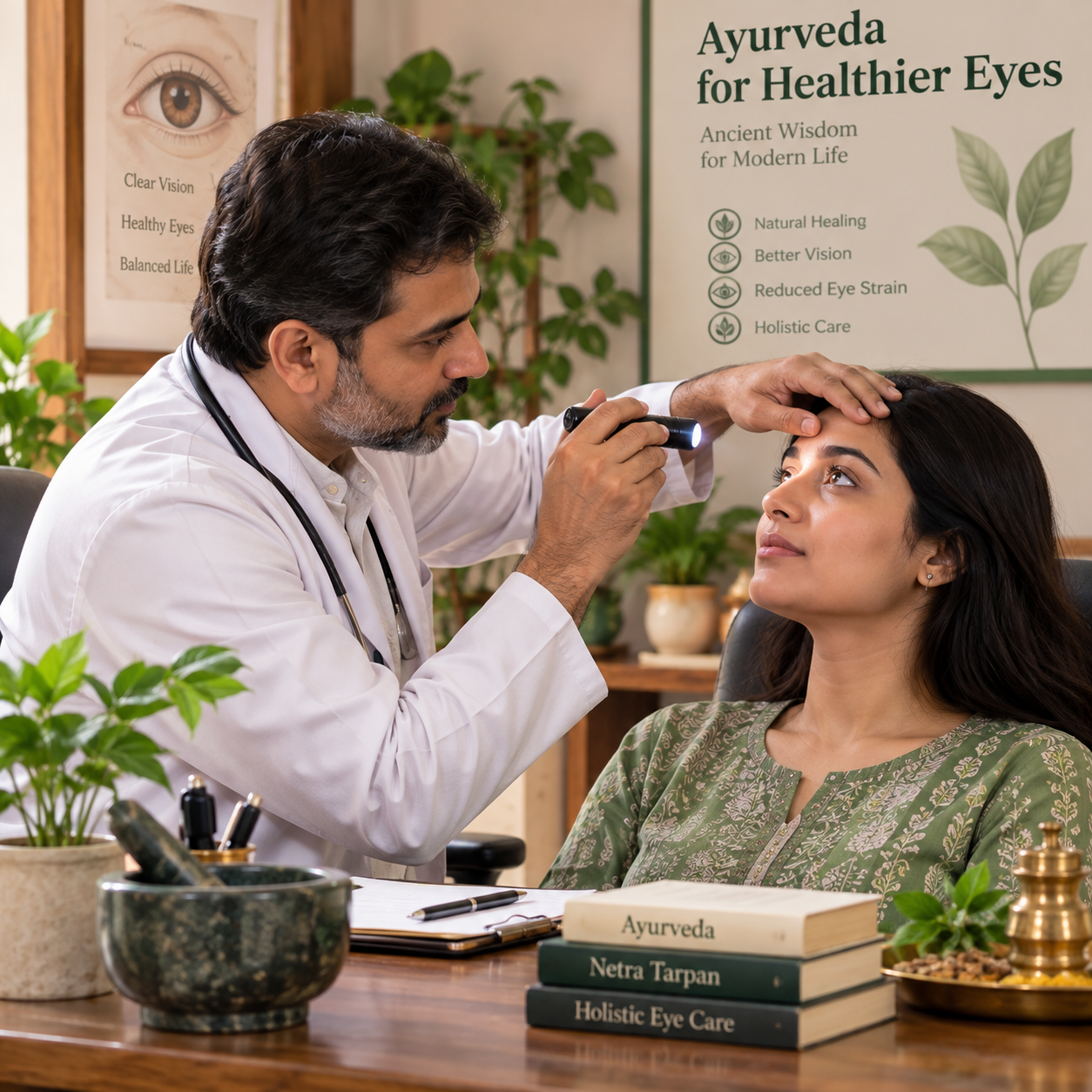
Netra Tarpan involves direct contact with the eye and should only ever be performed by a trained Ayurvedic physician — never attempted at home. It is generally avoided or postponed in cases of active eye infection or conjunctivitis, immediately after certain eye surgeries, and in a few other situations that a doctor will screen for during consultation. Ghee quality, temperature, and formulation also need to be clinically appropriate for the individual — this is precisely the kind of judgement call that separates a doctor-led Ayurvedic eye-care programme from an unsupervised wellness treatment.
How We Assess You Before Netra Tarpan
- Detailed history: Screen-time habits, occupation, sleep pattern, and onset of symptoms
- Netra Pariksha (eye examination): Checking for redness, dryness, discharge, or signs of active infection
- Prakriti-Vikriti assessment: Identifying your constitution and the current Vata-Pitta imbalance
- Review of existing eye reports, where available, especially for anyone with a known refractive error or diagnosed eye condition
This mirrors the same assessment-first philosophy we apply across our Panchakarma programmes — you can read more about what Panchakarma actually involves and how a treatment plan is built around your individual constitution.
Netra Tarpan as Part of a Complete Panchakarma Protocol
For occasional, mild digital eye strain, Netra Tarpan alone — alongside diet and lifestyle correction — is often enough. For more chronic, stress-linked, or recurrent cases, it's frequently paired with one or more classical Panchakarma procedures as part of a broader ayurvedic Panchakarma treatment in Pune, based on what the doctor identifies during assessment.
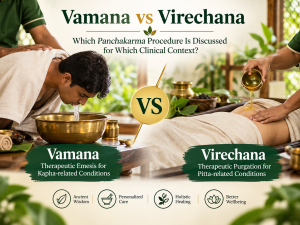
Virechana
A therapeutic purgation used to clear excess Pitta from the system — often considered in chronic, Pitta-dominant eye strain and irritation.
Nasya
Nasal-administered therapy that, in classical Ayurveda, supports the head and neck region — including the optic nerve pathway — and is commonly used alongside Netra Tarpan for screen-related fatigue.
Basti
Considered for Vata pacification in cases where chronic stress, poor sleep, and tension are contributing to persistent eye dryness and fatigue.
Vamana
Occasionally relevant where Kapha-type heaviness, puffiness, or congestion around the eyes accompanies the presenting complaint.
Raktamokshana
Used in select, localised Pitta-blood-related conditions in the eye region, on the treating doctor's specific recommendation.
Full Eye-Care Protocol
Read more on our dedicated Ayurvedic eye care and Netra Tarpan page for the complete range of eye therapies offered at our Kharadi clinic.
Which of these, if any, is added to your plan depends entirely on your doctor's assessment — Netra Tarpan is rarely prescribed as an isolated, generic package.
Herbs & Ghee Formulations Used
The medicated ghee used in Netra Tarpan is prepared by processing cow ghee with specific herbs, then heating and straining it to the correct consistency. Commonly used formulations and supporting herbs include:
- Triphaladi Ghrita / Mahatriphala Ghrita: Triphala-infused ghee widely used for its cooling, Pitta-pacifying, and nourishing effect on the eyes
- Jeevantyadi Ghrita: A classical formulation used specifically in Netra Kriyakalpa procedures
- Triphala (internal and as an eye wash): Used as a Rasayana for the eyes, and — under a doctor's guidance — as a strained decoction wash
- Rasanjana (Berberis aristata extract): Used in classical Anjana (herbal collyrium) preparations to support ocular clarity
- Amalaki (Amla): A key Rasayana herb supporting eye tissue nourishment as part of the broader diet and herbal plan
Note: Ghee grade, herb combination, and dosage must be individualised by your treating doctor. Self-administering any of these formulations at home, particularly around the eyes, is not advisable.
Diet & Lifestyle for Digital-Age Eyes
Supportive Habits
- Follow the 20-20-20 rule: every 20 minutes, look at something 20 feet away for 20 seconds
- Blink consciously and more frequently during screen work — screen use naturally reduces blink rate
- Include ghee, Amla, carrots, leafy greens, and almonds in your regular diet
- Reduce screen exposure in the hour before sleep, and aim for an earlier bedtime — night is considered Pitta time in Ayurveda, and staying up late aggravates it
- Use adequate ambient lighting and avoid working in a very dark room lit only by a screen
What Aggravates Digital Eye Strain
- Long uninterrupted screen sessions without breaks
- Excessive spicy, fried, or heating foods that aggravate Pitta
- Chronic sleep deprivation and irregular sleep timing
- Working in strong air-conditioning without adequate humidity or blinking
Sessions & Treatment Timeline
Netra Tarpan is typically administered as a short course of consecutive sessions rather than a single sitting, since classical texts describe the therapy's cumulative nourishing effect building over several days. As a general guide:
- Mild, occasional strain: A short course, often combined with diet and lifestyle correction, with the doctor reassessing after the initial sessions
- Moderate, recurring dryness or fatigue: A longer supervised course, sometimes paired with Nasya for combined effect
- Chronic or stress-linked cases: Netra Tarpan integrated into a broader Panchakarma plan involving Virechana or Basti, spread over a longer treatment window
Your doctor will confirm the exact number of sittings and spacing based on your specific assessment — this is not a fixed, one-size-fits-all number.
Netra Tarpan Cost in Pune: What Affects the Price
As with any genuine Ayurvedic therapy, there's no single fair number for Netra Tarpan treatment in Pune — cost depends on what's actually involved in your specific plan.
Number of Sittings
A single session is priced differently from a supervised multi-day course.
Ghee & Herb Formulation
Specialised classical formulations (like Jeevantyadi Ghrita) cost more than a standard plain ghee preparation.
Combined Panchakarma Add-Ons
If Nasya, Virechana, or Basti are added to your plan for chronic cases, the overall package cost reflects the additional procedures.
Doctor Consultation & Follow-Up
Ongoing review during the course, not just an intake consultation, is part of what a genuine clinic charges for.
For a broader look at how Panchakarma-linked therapies are typically priced, see our page on Panchakarma treatment cost in India and AYUSH rate references. The most reliable way to know your exact cost is a consultation — ask for an itemised quote rather than comparing a single headline figure across clinics.
Netra Tarpan in Kharadi & Wagholi, Pune
Ayusanjivani Ayurveda Centre offers doctor-supervised Netra Tarpan and broader Ayurvedic eye care at both our Pune clinics, following the same assessment-first protocol described throughout this guide.
📍 Ayusanjivani — Kharadi
Home to our dedicated Ayurvedic eye-care programme. Learn more on our Ayurvedic eye care page and our Panchakarma treatments in Kharadi, Pune.
Call Kharadi Clinic📍 Ayusanjivani — Wagholi
The same doctor-led Netra Tarpan and Panchakarma protocols, extended to patients across Wagholi and the Nagar Road belt.
WhatsApp Wagholi ClinicBoth clinics are supervised directly by Dr. Phalle, ensuring consistent quality of assessment and care regardless of which location is more convenient for you.
Reviewed by Dr. Shailesh Shamkant Phalle
BAMS, M.D. (Kayachikitsa) — Ayurvedic Physician & Panchakarma Specialist, Ayusanjivani Ayurveda Centre, Kharadi & Wagholi, Pune.
This article is for general health education and does not replace an in-person evaluation by a qualified Ayurvedic doctor or ophthalmologist. Netra Tarpan carries contraindications, including active eye infection, and should only be performed by a trained practitioner after proper assessment.
Frequently Asked Questions
Yes, when performed by a trained Ayurvedic doctor after a proper eye examination. It's one of the most commonly recommended therapies for people with heavy daily screen exposure, though the exact course and frequency should be decided individually.
Eye drops and blue-light glasses manage symptoms during screen use. Netra Tarpan works by directly nourishing and lubricating the ocular surface with medicated ghee, aiming at the underlying Vata-Pitta imbalance rather than only masking discomfort.
This varies by severity — mild, occasional strain may need only a short course, while chronic or recurrent dryness and fatigue is usually managed with a longer, doctor-supervised programme, sometimes combined with Nasya or other Panchakarma therapies.
Netra Tarpan is classically indicated for exactly these conditions — dry eyes, eye strain, and computer vision syndrome — and is widely used for this purpose. Individual response varies, and a doctor's assessment will confirm whether it's appropriate for your specific case.
This needs to be discussed directly with your doctor during consultation, since timing after eye surgery and contact lens use are both factors that affect whether and when the therapy is appropriate.
Netra Tarpan supports overall eye comfort, nourishment, and function, particularly for functional strain from screen use. Refractive errors like myopia are structural conditions, and Netra Tarpan is not a substitute for corrective lenses or an ophthalmologist's evaluation — it should be seen as supportive eye care rather than a vision-correction treatment.
Yes, Ayusanjivani Ayurveda Centre offers doctor-supervised Netra Tarpan and Ayurvedic eye care at both our Kharadi and Wagholi clinics in Pune. Call +91 84323 29371 or message us on WhatsApp to book at your preferred location.